What Is a Tracker Control Unit (TCU) and How Does It Work?
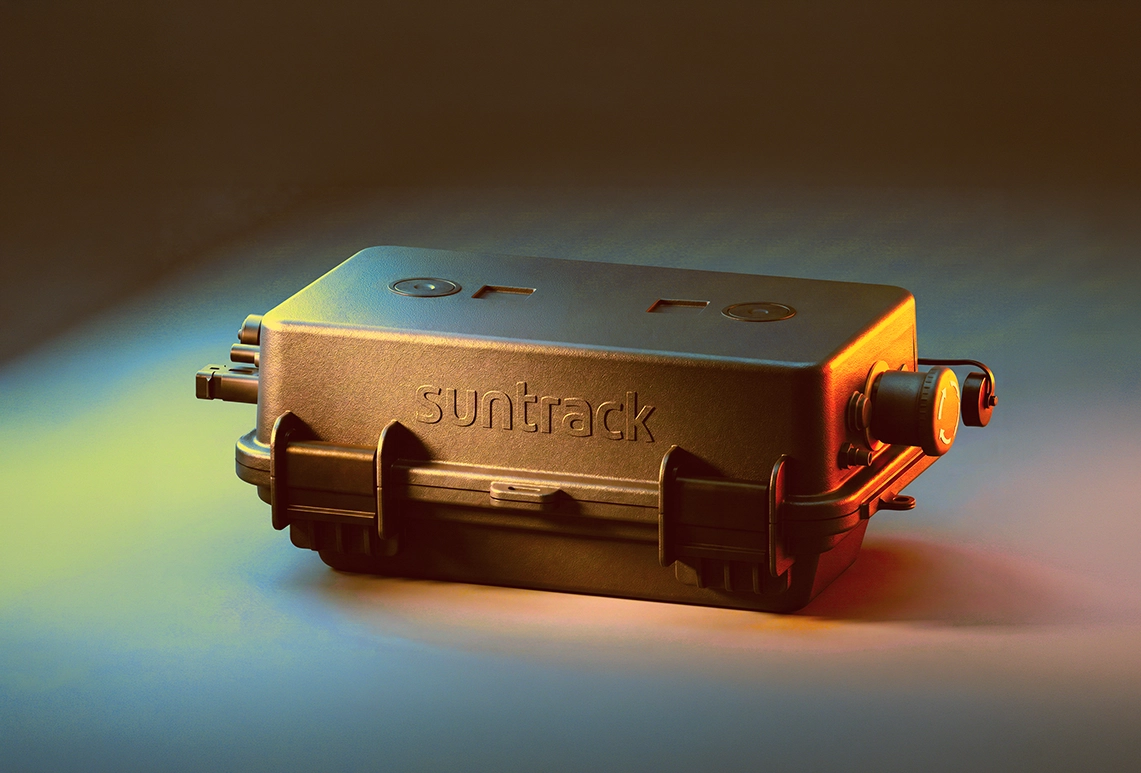
A Tracker Control Unit (TCU) is the embedded electronic controller mounted on each single-axis solar tracker that calculates the optimal tilt angle and drives the tracker motor so the photovoltaic modules follow the path of the Sun. It is the smallest decision-making device in a utility-scale PV plant and, because it acts thousands of times per site every day, one of the most consequential for energy yield.
Utility-scale PV has become a game of fractions of a percent. Module efficiency, inverter losses and soiling are all optimised aggressively. Tracking control, by contrast, is often specified as a commodity line item even though the angle each tracker holds at any given minute directly determines how much irradiance the array captures. This article explains what a TCU does, how it makes decisions, and why the quality of that decision-making shows up in the plant’s production curve.
The problem: a tracker is only as good as its control logic
A single-axis tracker is a mechanical asset — torque tube, bearings, drive, structure. Left alone, it does nothing. The energy gain attributed to “tracking” is in fact produced by a control decision: what angle should this specific tracker hold, right now, given the sun position, the terrain, the sky conditions and the weather risk?
That decision has to be made under real constraints:
- Terrain is no longer flat. As flat sites have become scarce, projects are built on rolling and irregular topographies where a single uniform angle causes row-to-row shading.
- Skies are not always clear. Under overcast conditions, pointing straight at the sun captures less energy than a flatter angle that harvests diffuse irradiance from a wider portion of the sky dome.
- Weather is a financial risk. Hail, extreme wind, flooding and snow can damage modules and structures in minutes.
- Connectivity is imperfect. A control strategy that depends on a permanent link to a central server inherits every communication fault on the site.
The TCU is where all of these constraints are resolved — locally, per tracker. Discover with our team which TCU best suits the needs of your PV project.
How a Tracker Control Unit works
1. It calculates where the Sun is
The TCU runs a built-in solar position algorithm. Rather than relying on a light sensor, it computes the sun’s position astronomically for the tracker’s coordinates and time, which makes tracking deterministic and immune to sensor drift or dirt.
2. It measures where the tracker actually is
Suntrack’s TCU uses an integrated accelerometer for accurate inclination measurement. This closes the loop: the controller compares the commanded angle with the physically measured angle and drives the motor until the angle of incidence between incoming sunlight and the panel is minimised. Without inclination feedback, a controller is estimating position rather than knowing it.
3. It applies backtracking to avoid self-shading
Early and late in the day, following the sun directly would make each row shade the next. Backtracking rotates the trackers back toward horizontal to eliminate that shading. On irregular terrain, a simple 2D backtracking model — which assumes uniform slopes — leaves yield on the table.
3D Backtracking®, embedded in the Suntrack TCU, computes the optimal angle for each individual tracker taking the real three-dimensional topography into account, increasing capture surface by up to 5.93%. Crucially, it runs locally: all site processing is done before delivery, and each TCU then operates independently using a few dozen registers and a fast transfer function. No external commands, no additional hardware, no dependency on the network staying up.
4. It adapts to sky conditions
Under diffuse-dominant conditions, conventional approaches require dual pyranometers, satellite data or on-site skycams — all of which add cost, computation and data flows. Suntrack’s Advanced Overcast algorithm estimates Beam Tilted Irradiance (BTI) and Diffuse Horizontal Irradiance (DHI) from a single measured value of Global Horizontal Irradiance (GHI) plus the theoretical solar elevation, then corrects tracker position accordingly.
The result: up to +5.51% energy production during overcast periods, using a single horizontal pyranometer, with fully local operation, no internet connection and no calibration or training period.
5. It protects the asset when weather turns
A modern TCU is also a risk-management device. Suntrack’s Severe Weather Protection System includes:
- Hail: automatic tracker positioning based on nowcast hail predictions, fed by real-time meteorological sources integrated into the monitoring platform.
- i-Stow®: proprietary intelligent wind stow using ultrasonic anemometers, with progressive and variable stow angles adjustable tracker by tracker.
- i-Flood: proprietary flood algorithm using ultrasonic sensors to adapt tracking angles to each tracker’s position and terrain irregularities.
- Low-temperature operation: Self-Powered units operating successfully down to −30 ºC (−22 ºF), with over 25,000 devices deployed.
Additional embedded functionalities include Winter Mode and Dynamic Limits.
FAQ
What does TCU stand for in solar?
TCU stands for Tracker Control Unit — the embedded controller that drives and positions a single-axis solar tracker.
Does a TCU need an internet connection?
Not for core tracking. Suntrack’s 3D Backtracking® and Advanced Overcast algorithms run locally inside each TCU; site data is processed before delivery and the unit then operates autonomously.
How is a TCU powered?
Four architectures are available: String Powered (300/400–1500 Vdc, directly from the array), Self Powered, Self Powered Plus (which removes the need for a dedicated pony panel), and AC Powered (110/220/277 V). Output power options range from 150 W to 300 W.
Is a TCU compatible with any tracker?
Suntrack’s TCU is adjustable to different single-axis tracker structures, adaptable to a variety of motors, and compatible with 1P, 2P, 3L and dual-row configurations.
In short
The Tracker Control Unit is where solar tracking stops being mechanical and becomes intelligent. With more than 1,000,000 TCUs delivered, over 50 GW of PV and CPV installed across 4,000+ solar sites in more than 40 countries, and 25 years of in-house electronics design and manufacturing, Suntrack builds tracking control as a yield-optimisation system.
Share this article
Share on WeChat
Scan with WeChat